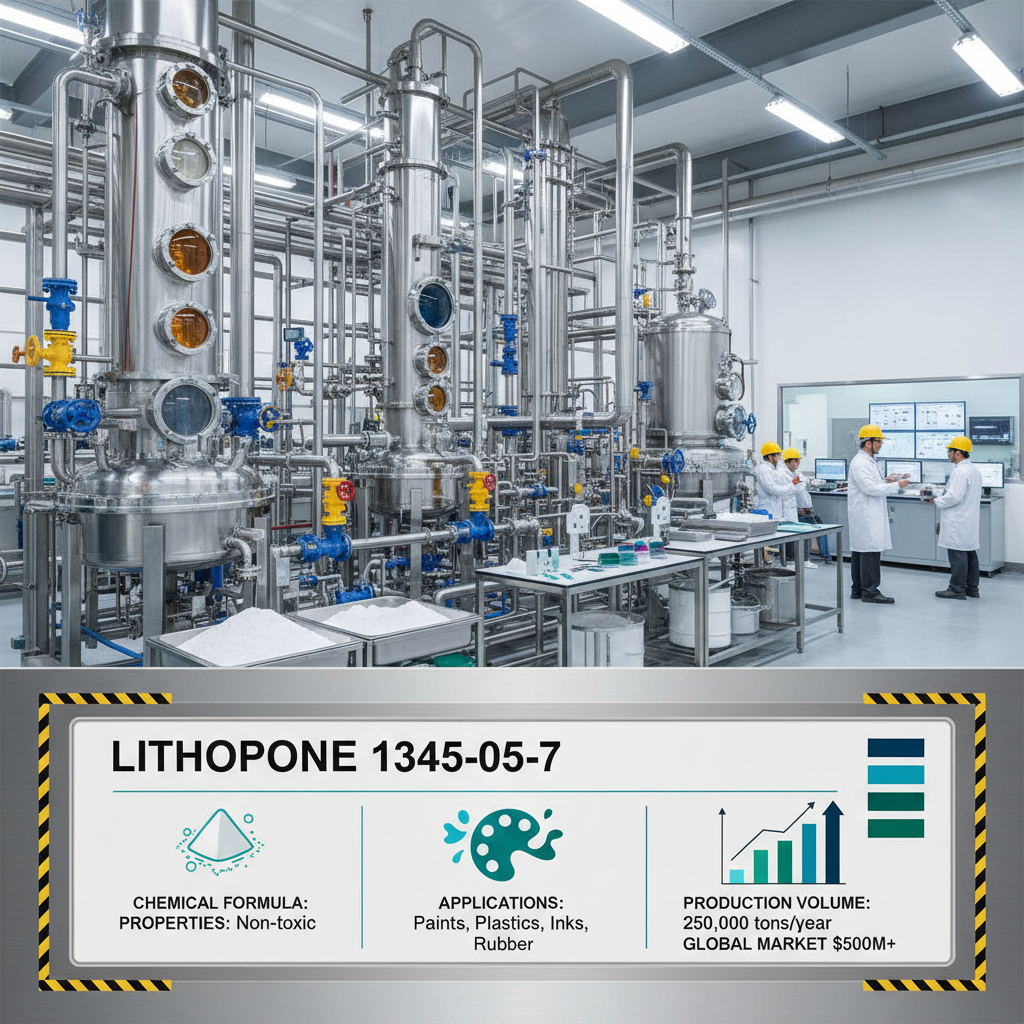
Lithopone 1345-05-7, a fascinating blend of zinc sulfide and barium sulfate, represents a significant achievement in pigment technology. Initially developed as a more cost-effective alternative to litharge (red lead) and white lead, its unique properties have secured its place across diverse industries. Understanding lithopone 1345-05-7 is crucial not just for pigment manufacturers, but also for those involved in plastics, coatings, and even certain specialized applications demanding a reliable, bright white pigment. lithopone 1345-05-7 continues to evolve, driven by demands for sustainability and performance.
Globally, the demand for white pigments remains consistently high, driven by population growth and expanding industrial sectors. According to recent market reports, the pigment market is projected to reach \$30.8 billion by 2027, with zinc-based pigments like lithopone 1345-05-7 playing a substantial role. However, environmental concerns surrounding traditional heavy metal-based pigments have created a pressing need for viable, eco-friendly alternatives. lithopone 1345-05-7 answers this need by providing a robust and less toxic option.
The growing construction and automotive industries, particularly in emerging economies, are significant drivers for pigment demand. Understanding the characteristics and applications of pigments like lithopone 1345-05-7 is paramount for innovation and efficiency in these sectors. This understanding allows for optimized formulations, improved product performance, and reduced environmental impact.
Introduction to lithopone 1345-05-7
Lithopone 1345-05-7’s initial success stemmed from its ability to mimic the opacity and brightness of lead-based pigments, but without the associated toxicity. This characteristic made it an immediate favorite in applications where safety was paramount. The composition, a carefully controlled mixture of zinc sulfide and barium sulfate, grants it a unique combination of properties. lithopone 1345-05-7's enduring relevance demonstrates the power of smart material science.
Beyond its initial role as a substitute, lithopone 1345-05-7 has found niche applications where its specific properties – like its ability to scatter light effectively – are particularly valuable. The continuing need for cost-effective and versatile pigments ensures a continued demand for this compound across various manufacturing sectors.
Defining Lithopone 1345-05-7
Lithopone 1345-05-7 is a synthetic inorganic pigment composed primarily of zinc sulfide (ZnS) and barium sulfate (BaSO4). Its chemical formula isn’t a single, fixed entity but rather a ratio of these two compounds, typically ranging from 50/50 to 70/30 ZnS:BaSO4. This specific composition provides the characteristic white color and opacity that make it valuable in a variety of applications. The CAS registry number 1345-05-7 uniquely identifies this specific chemical mixture.
Its connection to modern industry lies in its utility as a cost-effective white pigment, particularly in situations where extremely high purity or durability isn’t essential. It functions by scattering light, creating a bright, opaque effect. This makes it suitable for paints, plastics, paper coatings, and a range of other products needing a white, covering base.
Understanding its role necessitates acknowledging its historical context. The development of lithopone 1345-05-7 addressed the urgent need to replace highly toxic lead-based pigments, contributing to improved worker safety and environmental protection in numerous industrial processes.
Key Chemical & Physical Properties
The key to lithopone 1345-05-7's performance lies in its specific chemical and physical properties. Its refractive index, a crucial factor in light scattering, is relatively high, contributing to its excellent opacity. Particle size distribution is meticulously controlled during manufacturing, optimizing light scattering efficiency and achieving the desired brightness. The stability of its chemical composition ensures consistent performance over time.
Chemically, lithopone 1345-05-7 is generally inert and resistant to most common solvents and chemicals. This stability contributes to its longevity in applications where exposure to harsh environments is anticipated. However, it is susceptible to degradation under prolonged exposure to ultraviolet (UV) radiation, which can lead to discoloration. The barium sulfate component provides chemical resistance, while the zinc sulfide contributes to the optical properties.
Physically, lithopone 1345-05-7 is a fine, white powder with a slightly granular texture. Its density is typically around 3.0 - 3.5 g/cm³. The particle size is critical, usually ranging from 1 to 5 micrometers, and is carefully controlled during production to maximize its scattering efficiency and overall performance as a pigment.
Performance Characteristics
Lithopone 1345-05-7 delivers consistent opacity and brightness, making it an excellent choice for applications where covering power is crucial. Its performance is often evaluated based on its tinting strength, oil absorption, and dispersion characteristics. These factors directly influence the final quality and appearance of the product it is incorporated into.
The pigment exhibits moderate resistance to weathering, making it suitable for some outdoor applications, but typically requires stabilization with UV absorbers for extended durability. Its cost-effectiveness is a major advantage, making it a practical solution for many large-scale industrial applications.
Lithopone 1345-05-7 Performance Metrics
Global Applications of lithopone 1345-05-7
Lithopone 1345-05-7 finds widespread application in the paints and coatings industry, providing an economical white pigment for interior and exterior paints. It is also frequently used in the production of plastics, enhancing opacity and brightness in various molded products. The paper industry utilizes it as a coating pigment to improve whiteness and printability.
In regions with developing economies, like Southeast Asia and parts of Africa, lithopone 1345-05-7 remains a popular choice due to its cost-effectiveness. It’s used extensively in the manufacturing of affordable paints for residential construction and basic industrial coatings. Even in developed nations, specific niche applications in plastics and paper continue to drive demand.
Advantages and Long-Term Value
The primary advantage of lithopone 1345-05-7 is its cost-effectiveness. Compared to titanium dioxide, a more premium white pigment, it offers a significantly lower price point, making it a viable option for applications where ultimate performance isn’t critical. This cost advantage translates into lower production costs for manufacturers and more affordable products for consumers.
Beyond cost, its relative chemical stability provides long-term value. It contributes to durable coatings and plastics, extending the lifespan of products and reducing the need for frequent replacements. Furthermore, the decreasing environmental concerns surrounding the use of heavier metal-based pigments make lithopone 1345-05-7 a more sustainable choice.
The social impact is also significant. Its affordability allows for wider access to quality coatings and plastics, improving living standards and supporting economic development in various communities.
Future Trends and Innovations
Ongoing research focuses on enhancing the UV resistance of lithopone 1345-05-7 through surface treatments and the addition of stabilizers. These innovations aim to broaden its application scope to include more demanding outdoor environments. Efforts are also underway to optimize its manufacturing process for increased efficiency and reduced environmental impact.
The integration of nanotechnology is another promising avenue. Nanoparticle coatings on lithopone 1345-05-7 particles could improve dispersion, enhance light scattering, and further boost its overall performance. The push for sustainable materials and circular economy principles will likely continue to drive innovation in this space.
Digitalization and automation in pigment manufacturing processes are also expected to play a role, allowing for tighter quality control and more consistent product characteristics, bolstering the position of lithopone 1345-05-7 in a competitive market.
Challenges and Solutions
One of the main challenges associated with lithopone 1345-05-7 is its lower UV resistance compared to titanium dioxide. This limits its use in applications requiring prolonged outdoor exposure. Another concern is the potential for discoloration over time due to sulfur oxidation.
Solutions involve incorporating UV stabilizers into formulations and employing surface treatments to protect the zinc sulfide component from oxidation. Exploring alternative barium sulfate grades with higher purity can also improve overall stability. Advanced manufacturing techniques that control particle size and morphology can further enhance its performance characteristics.
Furthermore, ongoing research into novel coatings and encapsulation technologies promises to address these limitations and unlock new application possibilities for this versatile pigment.
Summary of Lithopone 1345-05-7 Challenges and Potential Solutions
| Challenge Area |
Severity (1-10) |
Potential Solution |
Implementation Cost (1-10) |
| Low UV Resistance |
8 |
UV Stabilizer Incorporation |
4 |
| Sulfur Oxidation |
7 |
Surface Treatment & Encapsulation |
6 |
| Particle Agglomeration |
5 |
Improved Dispersion Agents |
3 |
| Color Consistency |
6 |
Advanced Process Control |
5 |
| Limited Durability |
7 |
Nanoparticle Coating |
8 |
| Cost Competition |
4 |
Process Optimization |
2 |
FAQS
While both are white pigments, titanium dioxide offers superior opacity and UV resistance. However, lithopone 1345-05-7 is considerably more cost-effective. Titanium dioxide excels in applications demanding long-term durability and brilliant whiteness, like high-end paints and coatings. Lithopone 1345-05-7 is often favored in applications where cost is a primary concern and extreme performance isn't crucial, such as certain plastics and paper coatings. The choice depends on the balance between cost and required performance characteristics.
Compared to traditional lead-based pigments, lithopone 1345-05-7 is significantly more environmentally friendly due to the absence of heavy metals. However, it’s not without environmental considerations. The production process requires energy, and the disposal of waste materials needs to be managed responsibly. Ongoing research aims to develop more sustainable manufacturing processes and explore potential recycling options for lithopone 1345-05-7.
In the plastics industry, lithopone 1345-05-7 is used to enhance opacity and brightness in a variety of molded products. It's frequently found in PVC pipes, films, and sheets where a consistent white color is desired. Its cost-effectiveness makes it an attractive option for large-volume plastic applications. It is important to note its suitability is best in indoor or shaded applications due to its limited UV resistance.
Particle size is a critical factor in lithopone 1345-05-7 performance. Smaller particle sizes generally lead to greater opacity and higher brightness due to increased light scattering. However, excessively small particles can agglomerate, reducing dispersion and decreasing performance. Manufacturers meticulously control particle size distribution during production to optimize the pigment’s optical properties and ensure consistent results.
Lithopone 1345-05-7 should be stored in a cool, dry, and well-ventilated area, away from direct sunlight and moisture. Exposure to humidity can cause clumping and reduce its dispersibility. It's also advisable to keep it sealed in its original packaging to prevent contamination. Proper storage ensures the pigment maintains its quality and performance characteristics.
While lithopone 1345-05-7 can be used in exterior paints, it's generally not recommended as a sole pigment due to its limited UV resistance. Prolonged exposure to sunlight can lead to discoloration and degradation. If used in exterior applications, it must be combined with UV absorbers and stabilizers to enhance its durability and prevent premature fading. Titanium dioxide is typically the preferred choice for exterior paints requiring long-term color retention.
Conclusion
In conclusion, lithopone 1345-05-7 remains a valuable and versatile pigment with a significant role in various industries. Its cost-effectiveness, coupled with its acceptable performance characteristics, makes it a practical choice for numerous applications, particularly in regions where affordability is paramount. Understanding its strengths and limitations is crucial for optimizing its use and ensuring consistent product quality.
Looking ahead, continued research and innovation will be essential to address the challenges associated with its UV resistance and sustainability. By embracing new technologies and refining manufacturing processes, lithopone 1345-05-7 can continue to contribute to the pigment industry and support a diverse range of applications for years to come. Visit our website to learn more about our lithopone 1345-05-7 products and solutions.