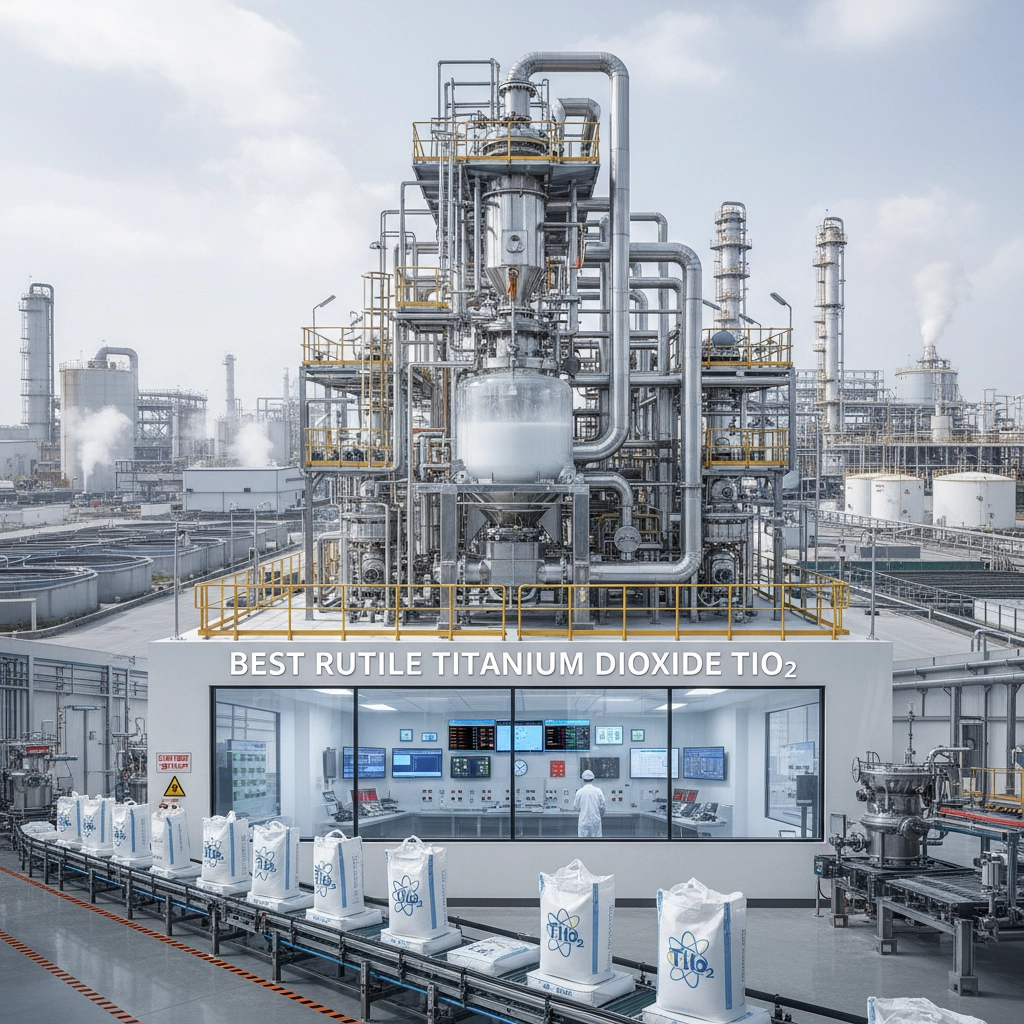
Finding the best rutile titanium dioxide tio2 is essential for manufacturers seeking unparalleled opacity and weather resistance in their end products. As a cornerstone of the inorganic salts and pigment industry, this white pigment is prized for its high refractive index, which allows it to scatter light more effectively than any other pigment, ensuring a brilliant white finish and superior hiding power.
The global demand for high-quality TiO2 continues to surge as industries shift toward more sustainable and durable materials. Whether it is used in high-performance automotive coatings or long-lasting architectural paints, the quality of the rutile crystal structure directly determines the longevity and aesthetic appeal of the coating, making the selection of the right grade a critical business decision.
Understanding the nuances between different manufacturing processes—such as the sulfate and chloride methods—allows procurement managers to optimize cost without sacrificing performance. By focusing on the best rutile titanium dioxide tio2, companies can reduce material consumption while enhancing the brilliance and durability of their product lines.
Global Market Relevance of Best Rutile Titanium Dioxide TiO2
The global market for titanium dioxide is heavily influenced by the construction and automotive sectors, where the best rutile titanium dioxide tio2 serves as the primary whitening agent. According to industry standards and ISO quality benchmarks, the rutile form is preferred over anatase due to its superior stability and resistance to UV degradation, which prevents "chalking" in outdoor environments.
However, the industry faces a constant challenge: balancing the extreme purity required for high-end applications with the environmental pressures of chemical manufacturing. As regulatory bodies tighten restrictions on emissions, the shift toward the "best" version of this pigment now includes not just performance, but the ecological footprint of its production process.
Defining the Best Rutile Titanium Dioxide TiO2 for Industry
In simple terms, the best rutile titanium dioxide tio2 is a high-purity inorganic pigment characterized by a specific crystal structure (rutile) that provides maximum light scattering. Unlike other white pigments, it is chemically inert and exceptionally stable, making it the gold standard for any application requiring a "true white" appearance and long-term durability.
From a technical perspective, "best" is defined by a combination of particle size distribution, surface treatment (often with alumina or silica), and the absence of impurities. These factors ensure that the pigment disperses evenly in various media—be it oil-based paints, plastics, or aqueous coatings—preventing clumps and ensuring a smooth, professional finish.
This material is more than just a colorant; it is a protective barrier. By reflecting a vast majority of UV radiation, it protects the underlying substrate (such as a car's metal body or a building's concrete) from photodegradation, thereby extending the lifecycle of the infrastructure and reducing maintenance costs globally.
Core Components and Quality Determinants
The efficacy of the best rutile titanium dioxide tio2 is largely determined by its refractive index. Rutile TiO2 possesses one of the highest refractive indices of any known transparent material, which is what allows it to provide such extreme opacity even in thin layers.
Surface coating is another critical factor. The best rutile titanium dioxide tio2 is typically encapsulated in a thin layer of inorganic oxides. This prevents the TiO2 from acting as a photocatalyst, which would otherwise break down the organic binders in paints and plastics, leading to premature cracking and fading.
Furthermore, particle size control is paramount. To achieve the best rutile titanium dioxide tio2 performance, particles are engineered to be approximately 200-300 nanometers. This specific size is optimal for scattering visible light, ensuring that the pigment provides the highest possible hiding power.
Performance Metrics and Comparative Analysis
When comparing different grades, professionals look at the "hiding power" and "gloss retention." The best rutile titanium dioxide tio2 consistently outperforms lower grades by requiring less pigment to achieve full coverage, which effectively lowers the total cost of the final formulation.
Below is a comparative analysis of different production methods and surface treatments to determine which configuration yields the highest industrial rating.
Industrial Performance Rating of Best Rutile Titanium Dioxide TiO2 Variants
Global Applications and Industrial Use Cases
The application of the best rutile titanium dioxide tio2 spans multiple continents and industries. In North America and Europe, it is heavily utilized in high-end automotive OEM coatings to ensure that vehicles maintain their luster under extreme weather conditions, from scorching summers to freezing winters.
In the Asia-Pacific region, particularly in rapidly urbanizing zones, the pigment is indispensable for architectural coatings. For instance, in large-scale infrastructure projects, using the best rutile titanium dioxide tio2 reduces the number of paint coats required, significantly accelerating construction timelines and lowering material waste.
Long-Term Value and Sustainability Advantages
Investing in the best rutile titanium dioxide tio2 provides tangible long-term value by extending the service life of coated products. When a coating doesn't fade or peel, the frequency of repainting is reduced, which leads to a significant decrease in the total volume of chemical solvents released into the environment over a decade.
From an economic standpoint, the superior opacity of high-grade rutile TiO2 allows formulators to use less pigment to achieve the same visual result. This efficiency lowers transport costs and reduces the carbon footprint associated with the logistics of heavy mineral pigments.
Moreover, the trust associated with using a premium grade ensures brand reliability. For manufacturers of plastic consumer goods or high-end cosmetics, the purity of the best rutile titanium dioxide tio2 ensures there are no toxic heavy metal contaminants, aligning the product with global safety standards and consumer health expectations.
Future Innovations in Rutile TiO2 Technology
The future of the best rutile titanium dioxide tio2 is moving toward "smart" pigments. Researchers are developing nano-engineered TiO2 that can actively reflect infrared heat, contributing to "cool roof" technologies that reduce energy consumption for air conditioning in tropical urban areas.
Digital transformation in manufacturing, such as AI-driven particle size monitoring, is allowing producers to create more consistent batches. This ensures that every shipment of the best rutile titanium dioxide tio2 meets exact specifications, eliminating the variability that often plagues lower-cost alternatives.
Sustainability is also driving the adoption of chlorine-recycling loops in the chloride process. By minimizing waste and energy consumption, the next generation of rutile pigments will not only be the best in performance but also the best in ecological harmony.
Comparative Analysis of Rutile TiO2 Production and Performance
| Production Method |
Opacity Rating |
UV Resistance |
Eco-Impact Score |
| Standard Sulfate |
7/10 |
Moderate |
Low |
| Premium Chloride |
9/10 |
High |
Medium |
| Alumina-Coated Rutile |
10/10 |
Excellent |
Medium |
| Silica-Coated Rutile |
8/10 |
High |
Medium |
| Nano-Engineered Rutile |
10/10 |
Superior |
High |
| Hybrid-Treated Rutile |
9/10 |
Excellent |
High |
FAQS
Rutile is the more stable crystal form of TiO2. While anatase is also white, it is photocatalytically active, meaning it breaks down organic binders when exposed to UV light, leading to "chalking." The best rutile titanium dioxide tio2 provides superior UV shielding, ensuring the paint remains intact and vibrant for years longer than anatase-based alternatives.
Surface treatments, usually involving alumina or silica, encapsulate the TiO2 particle. This "shield" prevents the pigment from reacting with the resin in the coating. Without this treatment, the best rutile titanium dioxide tio2 would be too reactive, potentially causing the coating to crack or yellow over time. Proper coating ensures optimal dispersion and weatherability.
While rutile TiO2 is used in both, the "best" grade depends on the medium. Plastic-grade TiO2 is optimized for high-temperature extrusion and melt-flow, whereas paint-grade is optimized for dispersion in liquids. Using a specialized best rutile titanium dioxide tio2 for each specific application ensures the highest opacity and prevents processing defects.
The chloride process generally produces a higher purity product with a more consistent particle size, often regarded as the best rutile titanium dioxide tio2 for high-end coatings. The sulfate process is more versatile for different raw materials and can be better for specific applications, but the chloride method is typically more efficient and produces less waste.
Verification should include checking the Certificate of Analysis (COA) for purity, particle size distribution, and oil absorption values. To ensure you have the best rutile titanium dioxide tio2, perform a draw-down test to measure opacity and a weather-o-meter test to simulate UV exposure and check for color retention.
Initially, premium rutile TiO2 may have a higher per-kilogram cost. However, because of its superior hiding power, you can use a lower concentration of the pigment to achieve the same opacity. This often results in a lower "cost-per-liter" for the finished paint or plastic, making the best rutile titanium dioxide tio2 more cost-effective in the long run.
Conclusion
Selecting the best rutile titanium dioxide tio2 is a strategic decision that impacts everything from product aesthetics to long-term structural durability. By focusing on key metrics such as refractive index, surface treatment, and crystal stability, manufacturers can ensure that their coatings and plastics withstand the harshest environmental conditions while maintaining a brilliant, professional white finish.
As the industry moves toward a greener future, the integration of nano-technology and sustainable production methods will further redefine what constitutes the "best" pigment. We encourage procurement professionals and engineers to prioritize high-purity, coated rutile grades to achieve a balance of performance, cost-efficiency, and environmental responsibility. Visit our website for more high-quality solutions: www.cqtitaniumdioxide.com