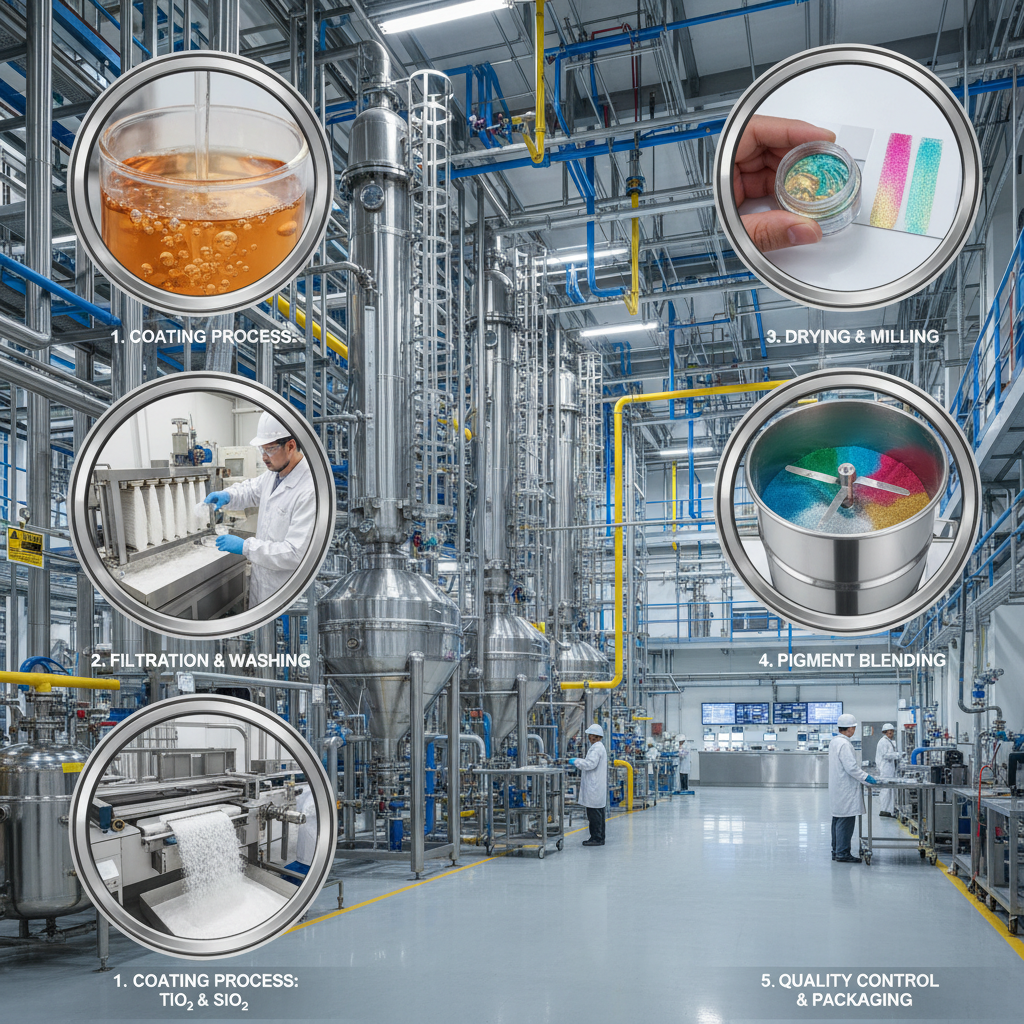
The allure of luminosity and iridescent color has always driven the evolution of industrial coatings, and at the heart of this aesthetic revolution is pearl pigment. These specialized materials are not merely additives but are complex engineered particles that manipulate light to create a shimmering, three-dimensional effect. In today's competitive manufacturing landscape, the ability to impart a high-end, metallic, or pearlescent finish is a critical differentiator for brands across the automotive, cosmetic, and architectural sectors.
Globally, the demand for high-performance effect pigments has surged as consumer preferences shift toward personalized and premium product finishes. From the sleek curves of a luxury electric vehicle to the subtle glow of high-end skincare packaging, the application of pearl pigment provides a unique intersection of chemistry and art. Understanding the technical composition and the optical properties of these pigments is essential for manufacturers looking to optimize their product appeal while maintaining stringent quality standards.
However, achieving the perfect "pearlescence" requires more than just adding a powder to a base. It involves a deep understanding of particle size distribution, refractive indices, and compatibility with other inorganic materials like Barium Sulfate or Titanium Dioxide. By mastering the integration of these pigments, industries can transition from flat, monochromatic surfaces to dynamic, light-responsive finishes that enhance both the perceived value and the functional durability of the final product.
The Global Significance of Pearl Pigment
In the global chemical market, pearl pigment has evolved from a niche luxury additive to a fundamental component of modern industrial design. According to ISO standards for pigment quality, the consistency of light interference is the primary benchmark for high-grade materials. As emerging economies in Asia and Latin America expand their automotive and consumer electronics sectors, the integration of these pigments has become a key driver in the "premiumization" of mass-market goods, allowing manufacturers to offer luxury aesthetics at scale.
The challenge facing the industry today is the balance between visual brilliance and environmental compliance. Many traditional pearlescent effects relied on heavy metals or unsustainable sourcing; however, the modern shift toward synthetic mica and silica-based substrates has revolutionized the supply chain. This transition not only ensures a more stable color profile but also aligns with global ESG (Environmental, Social, and Governance) mandates, making the use of advanced pigments a strategic move for companies aiming for long-term market viability.
Defining the Chemistry of Pearlescence
At its most basic level, a pearl pigment is a composite material consisting of a transparent substrate—typically mica or synthetic fluorophlogopite—coated with thin layers of metal oxides, such as titanium dioxide or iron oxide. Unlike conventional pigments that absorb and reflect specific wavelengths of light to produce a color, pearlescent pigments work through the principle of "thin-film interference." When light hits the layered structure, it reflects off both the surface and the internal interfaces, creating a shimmering effect that changes based on the angle of observation.
This unique optical property allows for the creation of a vast spectrum of colors, from brilliant whites and soft silvers to deep golds and iridescent greens, without the need for high concentrations of organic dyes. By varying the thickness of the metal oxide layer—often measured in nanometers—chemists can precisely tune the color of the reflection. This precision is what enables the cosmetics industry to create "glow" effects and the automotive industry to produce "flip-flop" paints that change color as a car moves through light.
Beyond the aesthetics, the chemistry of these pigments is designed for compatibility with various binders, including acrylics, epoxies, and polyurethanes. In the context of inorganic salt manufacturing, the purity of the substrate is paramount. Any impurity in the mica or the oxide layer can lead to "spotting" or a dulling of the luster, which is why high-purity titanium dioxide is often the preferred coating material to ensure maximum brightness and weather resistance.
Core Technical Components of Effect Pigments
The performance of a pearl pigment is primarily determined by its substrate quality. Natural mica is widely used for its cost-effectiveness and excellent cleavage, which creates the necessary plate-like structure. However, synthetic mica is increasingly preferred for high-end applications because it lacks the iron impurities found in nature, resulting in a "cleaner" white and higher transparency, which enhances the overall brilliance of the interference color.
Another critical component is the coating layer, where Titanium Dioxide ($\text{TiO}_2$) plays a starring role. The refractive index of $\text{TiO}_2$ is exceptionally high, which maximizes the light reflection. When this is paired with a precisely controlled deposition process, the resulting pearl pigment achieves a level of luminosity that cannot be replicated by standard metallic powders, which often look "grainy" rather than "silky."
Finally, surface treatment agents are applied to the final particle to ensure optimal dispersibility. Without proper surface modification, these plate-like particles tend to clump together, leading to an uneven finish known as "streaking." By applying organic coatings or silane coupling agents, manufacturers ensure that the pigments align parallel to the substrate surface during the drying process, which is essential for achieving that signature mirrored shimmer.
Performance Metrics and Quality Standards
Evaluating the quality of a pearl pigment requires a combination of spectrophotometry and rheological testing. The most important metric is "hiding power" combined with "luster value." Unlike matte pigments, the goal here is not to block the base color entirely but to interact with it. Therefore, the transparency of the substrate and the uniformity of the coating thickness are the primary KPIs for quality control in a professional laboratory setting.
Furthermore, durability is a non-negotiable factor for industrial use. Pigments used in exterior architectural coatings or automotive paints must withstand UV radiation and chemical weathering without losing their iridescent properties. This is where the chemical stability of the metal oxide layer becomes critical; if the layer degrades, the "pearl" effect vanishes, leaving behind a dull, chalky residue.
Comparative Performance of Pearl Pigment Variants
Industrial Applications and Global Use Cases
The versatility of pearl pigment allows it to penetrate diverse markets. In the cosmetics industry, it is used in eyeshadows and nail polishes to create a "lit-from-within" glow. Because these applications require skin-safe materials, there is a heavy reliance on synthetic fluorophlogopite, which eliminates the risk of heavy metal contamination. In the plastics industry, these pigments are compounded into masterbatches for luxury packaging, giving bottles a metallic sheen that suggests high product value.
In more heavy-duty industrial contexts, such as automotive OEM coatings, pearl pigment is often used as a mid-coat or top-coat to add depth to the color. For example, in high-end electric vehicle finishes, pearlescent effects are used to emphasize the aerodynamic lines of the car body. Similarly, in the architectural sector, these pigments are integrated into high-performance floor coatings and facade paints in urban centers like Dubai and Singapore, where they help reflect solar heat while providing a modern, futuristic aesthetic.
Long-term Value and Sustainable Advantages
From a commercial perspective, the adoption of pearl pigment offers a significant return on investment by increasing the "perceived value" of the product. A product that looks premium often commands a higher price point, even if the cost of the pigment additive is relatively low compared to the total formulation. This psychological impact—associating luminosity with quality and innovation—is a powerful tool for brand positioning in a crowded global market.
Sustainability is the next frontier for effect pigments. The industry is moving away from bismuth oxychloride and other potentially irritant materials toward bio-based substrates and recycled mica. Furthermore, the high reflectivity of certain pearlescent coatings can contribute to "cool roof" technology, reducing the amount of energy required for air conditioning in hot climates by reflecting a larger portion of the infrared spectrum.
Moreover, the reliability of modern pearl pigment ensures that products maintain their appearance over a longer lifecycle. By reducing the frequency of repainting or product replacement, these materials contribute to a reduction in overall industrial waste. The marriage of durability and beauty creates a sustainable value loop that benefits both the manufacturer and the end consumer.
Future Innovations in Pigment Technology
The future of pearl pigment lies in "smart" coatings and digital transformation. We are seeing the emergence of thermochromic and photochromic pearlescents—pigments that change color in response to temperature or UV light. This could lead to automotive paints that change color based on the weather or smart packaging that alerts consumers when a product has been exposed to excessive heat, blending aesthetic appeal with functional utility.
Automation and AI are also refining the manufacturing process. Precision deposition techniques, such as Atomic Layer Deposition (ALD), allow for the creation of pigment layers with single-atom precision. This means that the color shift of a pearl pigment can be engineered to be far more vivid and specific than previously possible, opening the door to "hyper-realistic" colors that mimic rare gemstones or biological iridescent structures.
Finally, the integration of green chemistry is driving the development of water-based dispersion systems for effect pigments. By eliminating volatile organic compounds (VOCs) from the application process, the industry is making it possible to achieve luxury finishes while adhering to the strictest environmental laws. The goal is a fully circular economy where pigment substrates are sourced sustainably and can be recovered during the recycling of plastics and metals.
Technical Comparison of Pearl Pigment Substrates and Coatings
| Substrate Type |
Coating Material |
Optical Effect |
Industrial Grade |
| Natural Mica |
$\text{TiO}_2$ / $\text{Fe}_2\text{O}_3$ |
Classic Pearlescent |
Standard |
| Synthetic Mica |
High-Purity $\text{TiO}_2$ |
Brilliant White/Clear |
Premium |
| Silica |
Metal Oxide Layers |
Sharp Interference |
Cosmetic |
| Glass Flake |
Metal Oxide/Polymer |
Strong Metallic |
Industrial |
| Fluorophlogopite |
Mixed Metal Oxides |
High-Saturate Color |
High-End |
| Hybrid Polymer |
$\text{TiO}_2$ Nanospheres |
Soft Diffused Glow |
Specialty |
FAQS
Pearl pigments use thin-film interference via layered metal oxides on a substrate to create a shimmering effect that changes with the angle of light. Metallic pigments, usually made of aluminum or copper flakes, reflect light directly like a mirror, creating a more "solid" metal look. Pearl pigments are generally softer, more iridescent, and offer more color variety.
Yes, but it requires specific surface treatments. Because mica and silica substrates can be hydrophilic or hydrophobic, manufacturers apply specialty coatings to the pearl pigment particles to ensure they disperse evenly in water without clumping or settling, which is critical for maintaining a uniform pearlescent finish.
Streaking occurs when pigment particles do not align parallel to the surface. To prevent this, ensure proper agitation of the paint before use and apply using a technique that allows the solvent to evaporate at a controlled rate. Using high-quality pigments with optimized particle size distributions also significantly reduces the risk of streaking.
For high-end applications, yes. Synthetic mica (fluorophlogopite) is free from the iron impurities found in natural mica, leading to higher transparency and a brighter, "cleaner" color. While more expensive, it is the gold standard for cosmetics and premium automotive finishes where purity and brilliance are paramount.
The thickness of the titanium dioxide layer determines which wavelength of light is reflected. A very thin layer might produce a subtle silver or white effect, while slightly thicker layers, or the addition of other oxides like iron oxide, shift the reflection toward gold, red, or blue. This nanometer-level control is what creates the diverse color palette.
Most modern pearl pigments are designed to be non-toxic and inert. However, for food-contact or cosmetic use, it is essential to choose pigments that meet FDA or EU regulatory standards, specifically ensuring they are free from heavy metals and use approved substrates like synthetic mica or calcium sodium borosilicate.
Conclusion
In summary, pearl pigment represents a sophisticated synergy of inorganic chemistry and optical physics. By leveraging the unique properties of substrates like mica and the high refractive index of titanium dioxide, manufacturers can transform ordinary surfaces into extraordinary visual experiences. From the critical importance of particle alignment and purity to the expanding horizons of smart, responsive coatings, the role of effect pigments in modern industry is both foundational and transformative.
As we move toward a future defined by sustainability and digital precision, the evolution of these materials will continue to drive innovation in product design. Companies that invest in high-purity, eco-friendly pearlescent solutions will not only enhance their brand's aesthetic appeal but also ensure compliance with global environmental standards. To explore high-performance pigment solutions and enhance your product's luminosity, visit our website: www.cqtitaniumdioxide.com