

Mei . 14, 2026 09:46 Kembali kepada senarai
Improving Brightness in Paper Industry with Anatase Grade TiO2
The pursuit of visual perfection in the paper manufacturing sector is a continuous challenge that balances chemistry, physics, and cost-efficiency. As digital printing and high-end publishing demand surfaces that offer maximum contrast and vivid color reproduction, the role of mineral additives has become more critical than ever. Among the various solutions available, the strategic implementation of anatase titanium dioxide has emerged as the gold standard for producers aiming to achieve elite levels of luminosity. Unlike other industrial applications that might prioritize rugged weatherability, the paper sector focuses on optical purity and internal scattering efficiency, making the anatase crystal structure an indispensable asset in modern mills.
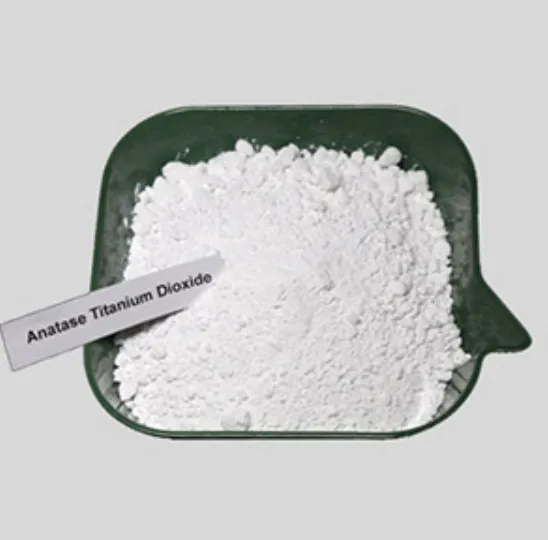
The Optical Superiority of Anatase Titanium Dioxide in Fiber Matrices
In the complex environment of a paper machine's wet end, the primary goal of adding pigments is to fill the microscopic voids between cellulose fibers. Anatase titanium dioksida is uniquely suited for this task due to its specific crystalline arrangement. While the rutile form is often cited for its high refractive index in coatings, the anatase variety offers a "bluer" white tone that is highly coveted in the production of fine writing papers and decorative laminates. This inherent blue-tinted whiteness offsets the natural yellowish hue of wood pulp, resulting in a final product that appears cleaner and more brilliant to the human eye.
Furthermore, the physical hardness of anatase titanium dioxide is significantly lower than that of the rutile form. In the high-speed environment of a paper mill, where slurries move through metallic screens and over drainage foils at immense velocities, the abrasiveness of a pigment can lead to premature equipment wear. By choosing the softer anatase crystal, manufacturers can maintain high pigment loading levels to achieve opacity goals without compromising the lifespan of expensive forming wires and cutting blades. This mechanical compatibility, combined with its superior light-scattering properties in thin sheets, makes it the preferred choice for lightweight coated papers where every gram of additive must perform at peak efficiency.
Integrating Titanium Dioxide for Paper Industry Sustainability and Efficiency
The modern shift towards lighter basis weights in packaging and publication paper has placed a massive burden on opacity. As paper becomes thinner, it naturally becomes more translucent, leading to the dreaded "show-through" effect where text from the reverse side interferes with the reader's experience. Utilizing titanium dioxide for paper industry applications solves this by providing a high-index barrier within the fiber network. Even at low dosage rates, these particles effectively redirect light, ensuring that the sheet remains opaque even when saturated with printing inks or subjected to intense backlighting.
Optimization of titanium dioxide for paper industry use involves a deep understanding of zeta potential and retention chemistry. Because TiO2 particles are significantly smaller than cellulose fibers, they tend to pass through the forming wire if not properly flocculated. Advanced mills use specialized retention aids to "tether" the titanium dioxide to the fibers. This ensures that the pigment is distributed uniformly throughout the Z-direction of the sheet, preventing two-sidedness—a defect where one side of the paper is significantly whiter or smoother than the other. When managed correctly, this integration results in a high-value sheet that meets the rigorous standards of high-speed offset and digital inkjet presses.
The Functional Role of Titanium Dioxide Brightening Agent in Surface Sizing
Beyond internal loading, the application of a titanium dioxide brightening agent during the surface sizing or coating process provides a secondary boost to a paper’s visual profile. Surface sizing involves applying a starch-based solution to the dried sheet to improve strength and ink holdout. By incorporating TiO2 into this size press formula, manufacturers can create a concentrated "optical shield" on the very surface of the paper. This is particularly effective for recycled fiber grades, which may have a gray or dull base color due to residual inks and contaminants.
The use of a titanium dioxide brightening agent allows mills to maintain high brightness standards while utilizing lower-cost, sustainable fiber sources. The pigment effectively masks the inconsistencies of the underlying pulp, providing a uniform, high-reflectance surface that is ideal for color-critical applications like corporate brochures and high-end packaging. Because the anatase grade disperses so readily in aqueous starch solutions, it creates a smooth, micro-porous surface that enhances ink setting times and prevents feathering, ensuring that every printed dot remains sharp and distinct.
Engineering Excellence with Titanium Dioxide Paper Pigment for Decorative Laminates
One of the most technically demanding segments of the market is the production of decor paper used in laminate flooring and furniture. Here, the titanium dioxide paper pigment must not only provide opacity but also withstand the intense heat and pressure of the lamination process. Decor papers require extremely high pigment loadings—often exceeding 40% by weight—to ensure that the dark substrate of the particleboard does not show through the printed woodgrain or solid color pattern.
The specialized titanium dioxide paper pigment used in these applications is often surface-treated to ensure maximum lightfastness. While TiO2 is a powerful UV absorber, it can also be photocatalytically active, which might lead to the yellowing of the resin over time. Manufacturers of high-end decor paper rely on premium anatase grades that have been stabilized to prevent this reaction, ensuring that the white kitchen cabinet or light-colored floor stays true to its original shade for decades. The ability to load such high levels of pigment without compromising the wet-strength or saturability of the paper is a testament to the advanced engineering behind modern anatase production.
Defining Quality with High Whiteness Titanium Dioxide Standards
For premium stationary and luxury packaging, the term "white" is a spectrum, and high whiteness titanium dioxide sits at the absolute peak of that range. Achieving this level of purity requires the removal of virtually all trace elements during the chemical manufacturing process. Any residual iron or vanadium would introduce a dulling effect, robbing the paper of its "pop." In the B2B marketplace, buyers of high whiteness titanium dioxide look for a material that provides a consistent Lab* color value, ensuring that a brand’s packaging looks identical whether it is produced in Europe, Asia, or North America.
This consistency is vital for global supply chains. When a luxury brand specifies a particular level of brightness for its shopping bags or gift boxes, the paper mill must rely on high whiteness titanium dioxide to hit those targets reliably across multiple production runs. The high scattering coefficient of this grade means that fewer optical brightening agents (OBAs) are needed. This is a significant advantage, as excessive OBA use can lead to "greening" of the sheet and may cause issues with skin sensitivity or food-contact regulations. By relying on the natural, mineral-based reflectance of high-purity TiO2, mills can produce a safer, more stable, and more aesthetically pleasing product.
-
The Role of High Purity Titanium Dioxide in Polymer Durability
BeritaMay.14,2026
-
Optimizing Industrial Coatings with Rutile Titanium Dioxide
BeritaMay.14,2026
-
Improving Brightness in Paper Industry with Anatase Grade TiO2
BeritaMay.14,2026
-
Enhancing Opacity in Premium Inks with Titanium Dioxide Pigment
BeritaMay.14,2026
-
Chemical Stability of Titanium Dioxide in Ceramic Glaze Applications
BeritaMay.14,2026
-
Advanced UV Protection: Titanium Dioxide for Construction Materials
BeritaMay.14,2026