

Mar . 05, 2026 01:45 Back to list
Comprehensive Guide to Chemical Formula of Lithopone Manufacturers and Applications
Chemical Formula of Lithopone Manufacturers: A Comprehensive Guide
Lithopone, a white pigment historically used as a substitute for lead white, is a fascinating compound with a specific chemical formula: ZnS·BaSO₄. This article will explore the manufacturing process of lithopone, key manufacturers, quality control measures, applications, and future trends. Understanding the intricacies of lithopone production and sourcing reliable manufacturers like CQ Titanium Dioxide is crucial for businesses seeking consistent quality and competitive pricing. We'll delve into the technical aspects, manufacturing nuances, and global market landscape of this important pigment.
Understanding the Chemical Formula and Composition of Lithopone
As previously mentioned, the chemical formula of lithopone is ZnS·BaSO₄, indicating it's a double sulfide composed of zinc sulfide (ZnS) and barium sulfate (BaSO₄). The ratio of these two components significantly impacts the pigment's properties, including its opacity, whiteness, and dispersibility. Ideally, lithopone contains approximately 30-50% zinc sulfide and 50-70% barium sulfate. The zinc sulfide provides the opacity, while the barium sulfate contributes to the pigment's brightness and chemical inertness. Variations in this ratio can lead to lithopone grades with different performance characteristics, tailored for specific applications. Ensuring the correct stoichiometry during manufacturing is critical for producing high-quality lithopone.
Key Takeaway: The chemical formula of lithopone (ZnS·BaSO₄) dictates its core properties. Precise control of the ZnS/BaSO₄ ratio is vital for achieving desired pigment performance.
The Manufacturing Process of Lithopone
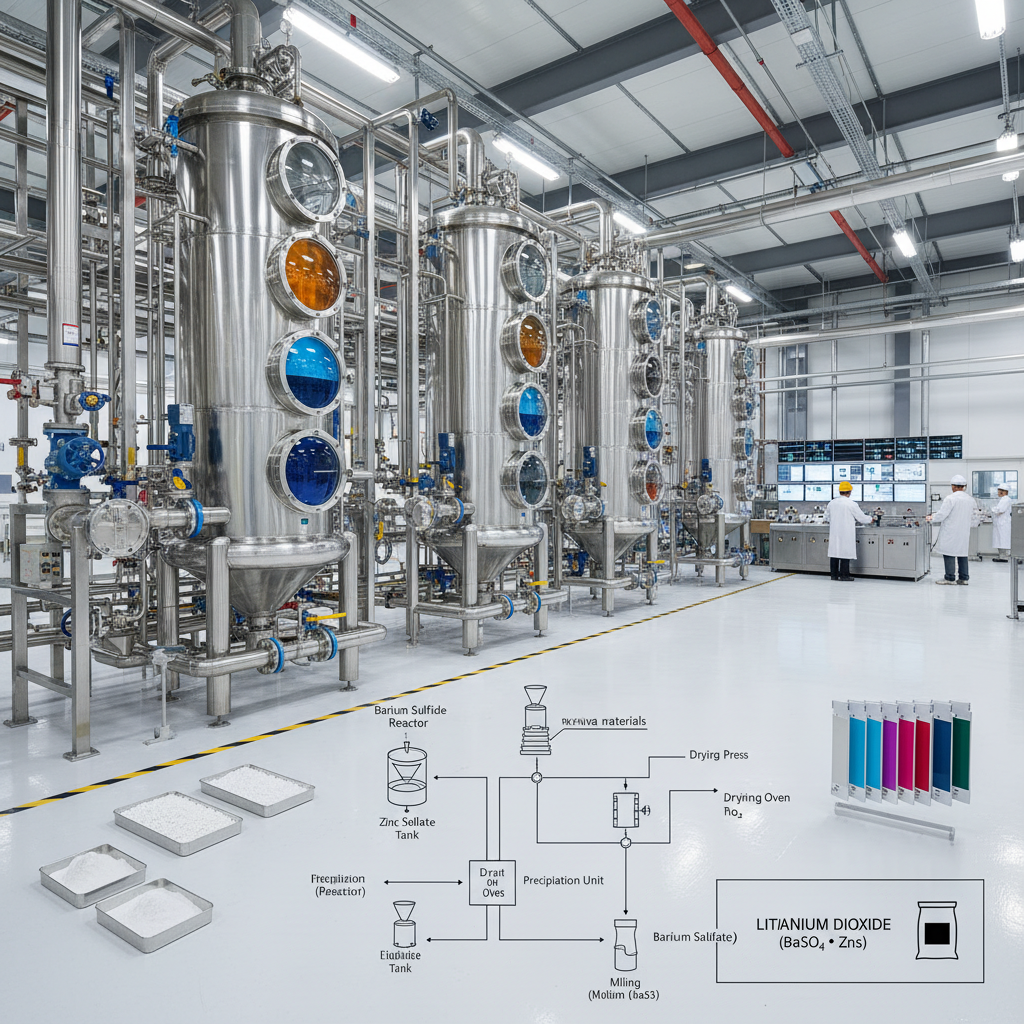
The production of lithopone typically involves a high-temperature reaction between barium sulfate and zinc sulfide. The process usually begins with the preparation of the raw materials: high-purity barium sulfate and zinc sulfide. These materials are then intimately mixed and heated in a rotary kiln or similar equipment to temperatures ranging from 1000-1400°C. This heating promotes a solid-state reaction, forming the desired lithopone compound. Following the reaction, the product is cooled, ground to a specific particle size, and often surface-treated to improve its dispersibility and compatibility with various application media. Rigorous quality control checks are implemented throughout the process to ensure consistent product quality.
Key Lithopone Manufacturers and Their Capacities
The lithopone market is dominated by a few key manufacturers, primarily located in China and India. These companies possess the necessary infrastructure, technical expertise, and raw material access to produce lithopone at competitive prices. CQ Titanium Dioxide stands out as a reliable supplier committed to quality and customer satisfaction. Below is a simplified overview of some major players:
Quality Control and Specifications for Lithopone
Maintaining consistent quality is paramount for lithopone manufacturers. Key quality control parameters include whiteness, brightness, oil absorption, particle size distribution, and heavy metal content. Manufacturers like CQ Titanium Dioxide employ sophisticated analytical techniques, such as X-ray diffraction, particle size analysis, and spectrophotometry, to ensure their products meet stringent specifications. Here's a typical specification sheet:

Applications of Lithopone and Future Trends
Lithopone finds application in various industries, including paints, plastics, paper, and rubber. It's particularly valued for its opacity and brightness. While titanium dioxide has largely replaced lithopone in many applications, lithopone remains a cost-effective alternative where high opacity isn't critical. Future trends suggest a focus on enhancing lithopone’s performance through surface modifications and nano-particle technologies, potentially expanding its applications in specialized coatings and composite materials. The pursuit of more sustainable manufacturing processes is also expected to gain prominence.
Conclusion: A Versatile Pigment with a Continued Role
Despite the rise of titanium dioxide, lithopone remains a valuable pigment, particularly for cost-sensitive applications. Selecting a reputable manufacturer like CQ Titanium Dioxide ensures access to high-quality lithopone with consistent performance. Understanding the chemical formula of lithopone (ZnS·BaSO₄) and its manufacturing nuances is crucial for making informed sourcing decisions.
Frequently Asked Questions (FAQs)
What are the key differences between lithopone and titanium dioxide?
While both lithopone and titanium dioxide are white pigments, titanium dioxide generally offers superior opacity, brightness, and weather resistance. However, lithopone is typically less expensive. Titanium dioxide (TiO₂) boasts a higher refractive index, leading to greater hiding power. Lithopone, with its chemical formula of ZnS·BaSO₄, relies on the combined effect of zinc sulfide and barium sulfate to achieve opacity. The choice between the two depends on the specific application requirements and budget constraints. For applications where cost is a primary concern and extremely high opacity isn't essential, lithopone remains a viable option.
Is lithopone environmentally friendly?
Lithopone itself isn’t considered highly hazardous, however, the manufacturing process can have environmental impacts. Concerns include energy consumption and potential emissions. Modern manufacturers are increasingly adopting cleaner production technologies to minimize their environmental footprint. Barium compounds can pose risks if improperly handled, so responsible waste management is crucial. Compared to some other pigments, lithopone generally has a lower environmental impact profile, but a full life cycle assessment is necessary for a comprehensive evaluation.
What applications are still well-suited for lithopone?
Lithopone continues to be effectively used in applications such as plastic compounding (particularly in PVC), paper coating, printing inks, and some types of rubber products. It’s also found in certain coatings where a balance between cost and performance is required. Its good dispersibility makes it suitable for applications where even distribution of the pigment is important. While not a direct replacement for titanium dioxide in high-performance coatings, it remains a valuable and economical pigment option in specific niche markets.
-
Why Rutile Titanium Dioxide is the Preferred Choice for Automotive Finishes
NewsApr.17,2026
-
Utilizing Anatase Titanium Dioxide for Inks and Specialized Printing Media
NewsApr.17,2026
-
The Science of Reflection: How Titanium Dioxide White Pigment Defines Modern Paints
NewsApr.17,2026
-
The Role of Coated Titanium Dioxide in High-Performance Exterior Coatings
NewsApr.17,2026
-
Enhancing Structural Longevity: Titanium Dioxide for Concrete and Masonry
NewsApr.17,2026
-
Comparing the Optical Efficiency of Rutile and Anatase Titanium Dioxide
NewsApr.17,2026